
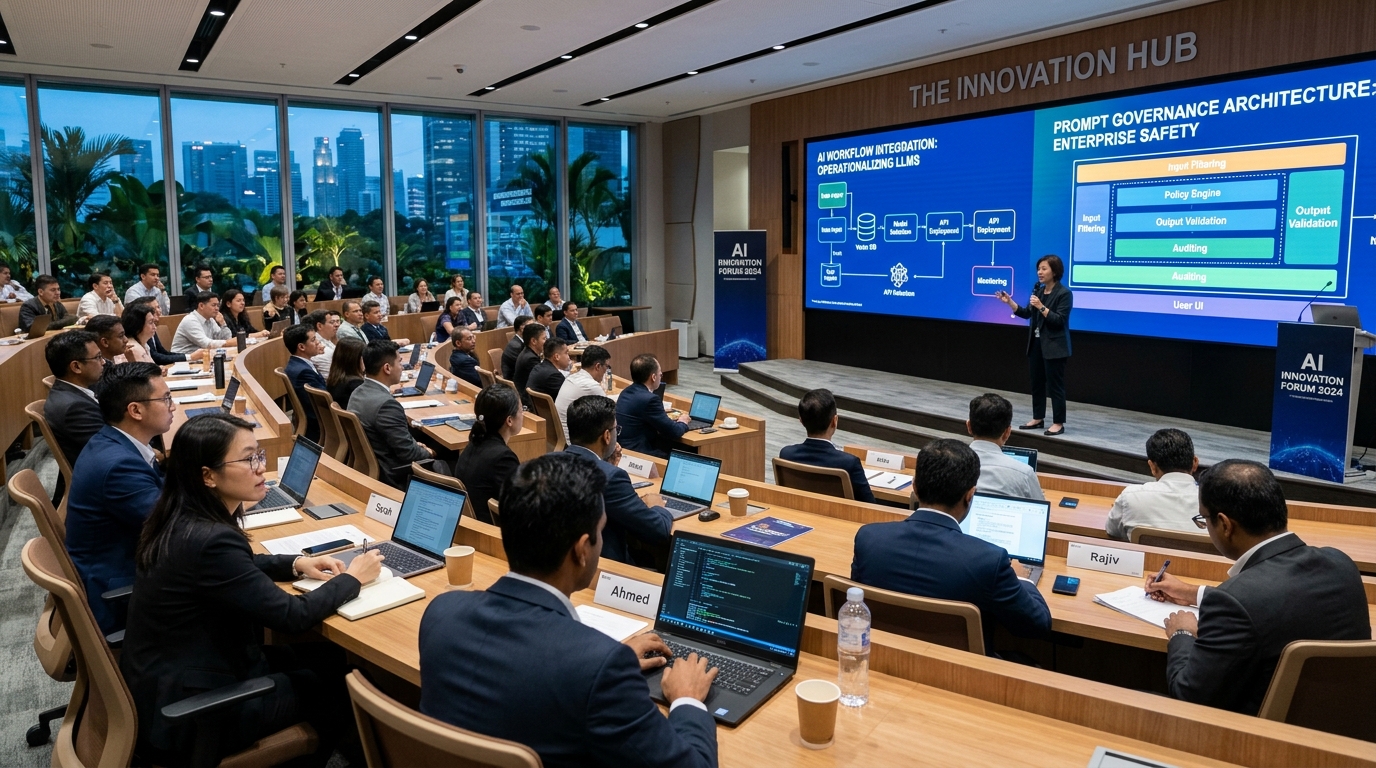


Practical Employee AI Training &
Workforce Enablement Programs.
Equip your workforce with practical prompt hygiene, safe data handling practices, role-specific workflows, and output verification discipline. Tailored for Singapore SME founders, HR leaders, and department heads who recognize that lasting AI productivity requires human adoption and critical oversight.
What should employee AI training cover for a Singapore company?
Employee AI training covers practical prompt hygiene, safe enterprise data handling under the Singapore PDPA, role-specific daily workflows for non-technical teams (operations, marketing, HR, customer service), and mandatory human verification discipline to ensure team members catch hallucinations and maintain accountability.
Reference: IMDA Singapore — Model AI Governance Framework (Human-in-the-Loop Oversight)Why technology adoption fails
without structured employee enablement.
Tools alone do not produce productivity. Lasting gains come from employees who know how to prompt, supervise, and verify AI outputs safely.

Structured Prompt Engineering & Output Verification
We train teams in role-specific prompt playbooks, mandatory verification discipline, and data protection hygiene, turning AI into a reliable daily assistant.
Unmonitored Shadow Habits
Employees experimenting with personal consumer accounts without clear guidelines on what data is safe to share with public AI models.
Vague, Low-Yield Prompting
Staff using one-line prompts, receiving generic or hallucinated text, and concluding that AI tools are ineffective for real business workflows.
Uncritical Verification Blindness
Copy-pasting model drafts directly into client emails or proposals without rigorous factual verification, risking corporate credibility.
Four core curriculum modules
tailored to business roles.
Grounded in daily business tasks—never theoretical academic lectures.
Data Hygiene & Acceptable Use
Clear, memorable guardrails on what proprietary data, customer PII, and financial information must NEVER be pasted into public models.
Role-Based Prompt Playbooks
Structured prompt engineering frameworks (Context, Task, Constraints, Persona, Schema) customized for operations and client communication.
Hallucination Defense & Review
Techniques to systematically cross-reference model outputs, verify quantitative figures, and catch fabricated citations before taking action.
Cognitive Workflow Integration
Practical methods to embed AI as a collaborative cognitive copilot within email, spreadsheets, document drafting, and meetings.
Ad-Hoc Internet Prompting vs. CROSVA Governed Workforce Enablement
| Training Dimension | Ad-Hoc / Self-Taught Prompting | CROSVA Structured Workforce Enablement | Operational Impact for Singapore SMEs |
|---|---|---|---|
| Data Protection (PDPA) | Zero awareness; employees paste customer NRICs into public chatbots | Rigorous Data Hygiene module defining non-negotiable boundaries | Eliminates company regulatory exposure and prevents data breaches |
| Prompt Architecture | Vague, single-sentence commands resulting in generic outputs | Engineered 5-part playbooks (Role, Context, Objective, Constraints, Schema) | Produces reliable, format-perfect outputs ready for business use |
| Verification Discipline | Blind trust; factual errors slip into client communications | Mandatory 3-step verification checklist (numeric, source, tone) | Protects corporate reputation and ensures human accountability |
| Department Alignment | Generic advice; high employee drop-off after 2 weeks | Hands-on practice using actual sanitized company workflows | Sustained 5–10 hours saved per employee weekly with 30-day follow-up |